Citation
CASE NO.: ICTR-95-1-I
THE PROSECUTOR OF TRIBUNAL
AGAINST
CLEMENT KAYISHEMA, IGNACE BAGILISHEMA, CHARLES SIKUBWABO,
ALOYS NDIMBATI, VINCENT RUTAGANIRA, MIKA MUHIMANA,
RYANDIKAYO, OBED RUZINDANA
FIRST AMENDED INDICTMENT
The Prosecutor of the International Criminal Tribunal for Rwanda, pursuant to his
authority under Article 17 of the Statute of the International Criminal Tribunal for
Rwanda ("the Statute of the Tribunal") charges:
1. This indictment charges persons responsible for the following massacres which
occurred in the Prefecture of Kibuye, Republic of Rwanda:
1.1 The massacre at the Catholic Church and the Home St. Jean Complex in Kibuye
town, where thousands of men, women and children were killed and numerous people
injured on about 17 April 1994.
1.2 The massacre at the Stadium in Kibuye town, where thousands of men, women and
children were killed and numerous people injured on about 18 and 19 April 1994.
1.3 The massacre at the Church in Mubuga, where thousands of men, women and
children were killed and numerous people injured between about 14 and 17 April 1994.
1.4 The massacres in the area of Bisesero, where thousands of men, women and children
were killed and numerous people injured between about 10 April and 30 June 1994.
THE MASSACRE SITES
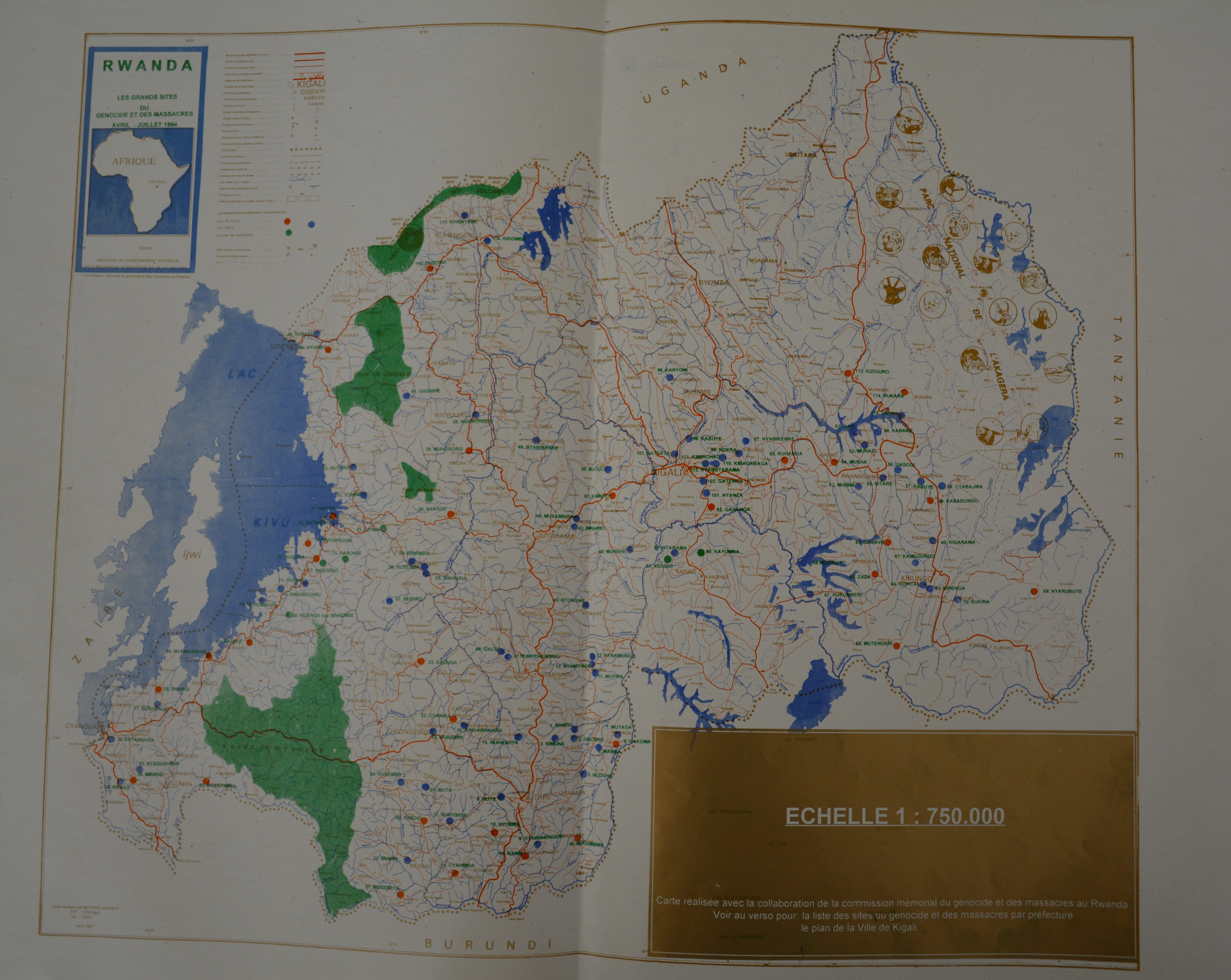
2. The Republic of Rwanda is divided into eleven Prefectures. These eleven Prefectures
are further divided into communes. The Prefecture of Kibuye consists of nine communes.
�The massacres which form the basis of the charges in this indictment occurred in the
Prefecture of Kibuye, in Gitesi, Gishyita and Gisovu communes.
3. The first massacre site addressed in this indictment, the Catholic Church and Home St.
Jean complex, is located in Kibuye town, Gitesi Commune, on a piece of land which is
surrounded on three sides by Lake Kivu. A road runs past the entrance to the Catholic
Church and Home St. Jean complex. The Catholic Church is visible from the road. The
Home St. Jean is behind the Church and is not visible from the road.
4. The second massacre site addressed in this indictment, the Stadium, is located near the
main traffic circle in Kibuye town, Gitesi Commune. The town's main road runs past the
Stadium. Immediately behind the Stadium is a high hill.
5. The third massacre site addressed in this indictment, the Church in Mubuga is located
in Gishyita Commune. Gishyita Commune is located in the southern part of Kibuye
Prefecture. The Church in Mubuga is located approximately 20 kilometres from Kibuye
town.
6. The fourth massacre site addressed in this indictment is the area of Bisesero. The area
of Bisesero extends through two communes in the Prefecture of Kibuye: Gishyita and
Gisovu. Bisesero is an area of high, rolling hills located in the southern portion of Kibuye
Prefecture. The hills are very large, and are often separated by deep valleys.
BACKGROUND
7. The structure of the executive branch, and the authority of the members therein, is set
forth in the laws of Rwanda. In the Prefecture, the Prefect is the highest local
representative of the government, and is the trustee of the State Authority. The Prefect
has control over the government and its agencies throughout the Prefecture.
8. In each commune within a prefecture there exists the council of the commune, which is
lead by the Bourgmestre of that commune. The Bourgmestre of each commune is
nominated by the Minister of the Interior and appointed by the President. As
representative of the executive power, the Bourgmestre is subject to the hierarchical
authority of the Prefect, but, subject to this authority, the Bourgmestre is in charge of
governmental functions within his commune.
9. The Prefect is responsible for maintaining the peace, public order, and security of
persons and goods within the prefecture. In fulfilling his duty to maintain peace, the
Prefect can demand assistance from the army and from the Gendarmerie Nationale. The
Bourgmestre also has authority over those members of the Gendarmerie Nationale
stationed in his commune.
10. The Gendarmerie Nationale is an armed force established to maintain the public order
and execute the laws. It is lead by the Minister of Defense, but can exercise its function
of safeguarding the public order at the request of the competent national authority, which
�is the Prefect. The Gendarmerie Nationale has an affirmative duty to report to the Prefect
information which has a bearing on the public order, as well as a duty to assist any person
who being in danger, requests its assistance. From January - July of 1994, they were
approximately 200 gendarmes in the Prefecture of Kibuye.
11. Members of the executive branch also have control over the communal police. Each
commune has Police Communale, who are engaged by the Bourgmestre of that
commune. Normally the Bourgmestre has exclusive authority over the members of the
Police Communale. In case of public calamities, however, the Prefect can claim the
policemen of the Police Communale and place them under his direct control.
12. The Interahamwe, an unofficial paramilitary group composed almost exclusively of
extremist Hutus, had significant involvement in the events charged in this indictment.
The National Revolutionary Movement for Development (MRND) party created the
Interahamwe as a military training organization for MRND youth and based the
Interahamwe's leadership on the MRND's own structure, with leaders at the national,
prefectoral, and communal levels. There was no official link between the Interahamwe
and the Rwandan military, but members of the Army and Presidential Guard trained,
guided and supported the Interahamwe. Occasionally, members of the Army or
Presidential Guard participated in Interahamwe activities.
13. On 6 April 1994, the airplane carrying then-president of Rwanda Juvenal
Habiyarimana crashed during its approach into Kigali airport in Rwanda. Almost
immediately, the massacre of civilians began throughout Rwanda. During that time
individuals seeking Tutsis were able to focus their activities on specific locations because
Tutsis, who believed themselves to be in danger, often fled in large numbers to perceived
safe areas, such as churches and communal buildings. This practice, which was widely
known, was based on the fact that in the past Tutsis who had sought refuge in such places
had not been attacked. Thus, during the period of time relevant to this indictment, groups
of people seeking refuge in the same area were most likely predominately Tutsis.
14. Also, during the times relevant to this indictment, the Rwandan government required
all Rwandans to carry, at all times, identity cards that designated the bearer's status as
Hutu, Tutsi, Twa or "naturalized". Individuals seeking Tutsis could identify their targets
simply by asking individuals to show their identification card.
GENERAL ALLEGATIONS
15. All acts or omissions by the accused set forth in this indictment occurred during the
period of 1 January 1994 to 31 December 1994 and in the territory of Rwanda.
16. In each paragraph charging genocide, a crime recognized by Article 2 of the Tribunal
Statute, the alleged acts or omissions were committed with intent to destroy, in whole or
in part, an ethnical or racial group.17. In each paragraph charging crimes against
humanity, crimes recognized by Article 3 of the Tribunal Statute, the alleged acts or
omissions were part of a widespread or systematic attack against a civilian population on
�political, ethnic or racial grounds.
18. At all times relevant to this indictment, the victims referred to in this indictment were
protected under Article 3 common to the Geneva Conventions and by Additional Protocol
II thereto.
19. At all times relevant to this indictment, there was an internal armed conflict occurring
within Rwanda.
20. At all times relevant to this indictment, Clement Kayishema was Prefect of Kibuye
and exercised control over the prefecture of Kibuye, including this subordinates in the
executive branch and members of the gendarmerie nationale.
21. At all times relevant to this indictment, Aloys Ndimbati was the Bourgmestre of
Gisovu Commune, Charles Sikubwabo was the Bourgmestre of Gishyita Commune, and
Ignace Bagilishema was the Bourgmestre of Mabanza Commune. Each exercised
control over his respective commune, including his subordinates in the executive branch
and members of the Police Communale and Gendarmerie Nationale.
22. Each of the accused is individually responsible for the crimes alleged against him in
this indictment, pursuant to Article 6(1) of the Tribunal Statute. Individual responsibility
includes planning, instigating, ordering, committing or otherwise aiding and abetting in
the planning, preparation or execution of any of the crimes referred to in Articles 2 to 4 of
the Tribunal Statute.
23. In addition, Clément Kayishema, Aloys Ndimbati, and Charles Sikubwabo are
also or alternatively individually responsible as superiors for the criminal acts of their
subordinates in the administration, gendarmerie nationale, and communal police with
respect to each of the crimes charges, pursuant to Article 6(3) of the Tribunal Statute.
Superior individual responsibility is the responsibility of a superior for the acts of his
subordinate if he knew or had reason to know that his subordinate was about to commit
such criminal acts or had done so and failed to take necessary and reasonable measures to
prevent such acts, or to punish the perpetrators thereof.
The Accused
24. Clement Kayishema was born in 1954 in Bwishyura Sector, Gitesi Commune,
Kibuye Prefecture, Rwanda. Kayishema's father was Jean Nayigiziki, and his mother
was Catherine Nyiramaronko. He was appointed to the position of Prefect of Kibuye on
July 3, 1992, and assumed his responsibilities as Prefect soon after. Clement Kayishema
acted as Prefect of Kibuye until his departure to Zaire in July 1994. He is believed to be
currently in Bukavu, Zaire.
25. Ignace Bagilishema was born in 1955 in Rubengera Sector, Mabanza Commune,
Kibuye Prefecture, Rwanda. Bagilishema's father was Louis Ntaganda, and his mother
was Kampundu. Ignace Bagilishema was appointed as Bourgmestre of Mabanza
�Commune on February 8, 1980. Bagilishema acted as Bourgmestre until the end of July
1994. He is believed to be currently in Zambia.
26. Charles Sikubwabo is believed to have been born in the early to mid-1940's in
Gishyita Sector, Gishyita Commune, Kibuye Prefecture, Rwanda. Sikubwabo's father
was Ferdinand Seburikoko. Charles Sikubwabo was appointed as Bourgmestre of
Gishyita Commune in 1993. Before this appointment, Sikubwabo was a Chief Adjutant
in the Armed Forces of Rwanda. Charles Sikubwabo acted as Bourgmestre until the end
of July 1994. He is believed to be currently in Bukavu, Zaire.
27. Aloys Ndimbati is believed to have been born in the early to mid-1950s in Gitabura
Sector, Gisovu Commune, Kibuye Prefecture, Rwanda. Aloys Ndimbati was appointed
as Bourgmestre of Gisovu Commune in 1990. Aloys Ndimbati acted as Bourgmestre
until the end of July 1994. He is believed to be currently in Zaire.
28. Vincent Rutaganira is believed to have been born in the early 1940's in Mubuga
Sector, Gishyita Commune, Kibuye Prefecture, Rwanda. Rutaganira's father was
Telesphore Bulimwinyundo, and his mother was Saverine Nyiramakuta. Vincent
Rutaganira was elected as Counsellor of Mubuga Sector, Gishyita Commune in 1980.
Vincent Rutaganira acted as Counsellor until the end of July 1994. He is believed to be
currently in Bukavu or on Ijwi Island, Zaire.
29. Mika Muhimana is believed to have been born around 1950 in Gishyita Sector,
Gishyita Commune, Kibuye Prefecture, Rwanda. Muhimana's father was Manasse
Ntamakemwa, and his mother was Thamar Mukamugema. Mika Muhimana was elected
as Counsellor of Gishyita Sector, Gishyita Commune in 1988. Before his election, Mika
Muhimana was a commercial trader. Mika Muhimana acted as Counsellor until the end
of July 1994. He is believed to be currently somewhere in Zaire.
30. Ryandikayo has no first name. He is believed to have been born around 1961 in
Musenyi Sector, Gishyita Commune, Kibuye Prefecture, Rwanda. Ryandikayo's father
was Rwuma (no first name), and his mother was Nyirabukeye (no first name).
Ryandikayo was the manager of a restaurant in Mubuga Sector, Gishyita Commune
during the time period in which the crimes alleged in this indictment occurred. He is
believed to be currently somewhere in Zaire.
31. Obed Ruzindana is believed to have been born around 1959 in Gisovu Sector,
Gisovu Commune, Kibuye Prefecture, Rwanda. Ruzindana's father was Elie Murakaza.
Obed Ruzindana was a commercial trader in Kigali and in Rwamatamu Commune,
Kibuye Prefecture during the time period in which the crimes alleged in this indictment
occurred. He is believed to be currently somewhere in Zaire.
CHARGES
The Agreement to Kill all Tutsis
�COUNT 1
32. Prior to the massacres which form the basis for counts 2 through 25 of this
indictment, Clement Kayishema, Ignace Bagilishema, Charles Sikubwabo, Aloys
Ndimbati, Vincent Rutaganira, Mika Muhimana, Ryandikayo and Obed Ruzindana
conspired to kill the Tutsis in Kibuye Prefecture.
33. In furtherance of the aims of this conspiracy, between about 9 April 1994 and about
30 June 1994, the above-named individuals murdered and assisted in the murder of Tutsis
throughout Kibuye Prefecture. The massacres which form the basis for counts 2 through
25 of this indictment were a result of this conspiracy.
34. By these actions, Clement Kayishema, Ignace Bagilishema, Charles Sikubwabo,
Aloys Ndimbati, Vincent Rutaganira, Mika Muhimana, Ryandikayo and Obed
Ruzindana are criminally responsible for:
Count 1: CONSPIRACY TO COMMIT GENOCIDE, a violation of Article 2(3)(b) of the
Tribunal Statute.
The Massacre at the Catholic Church and Home St. Jean Complex
COUNTS 2 - 7
35. By about 17 April 1994, thousands of men, women and children from various
locations has sought refuge in the Catholic Church and Home St. Jean Complex (the
Complex) located in Kibuye town. These men, women and children were unarmed and
were predominantly Tutsis. They were in the Complex seeking protection from attacks on
Tutsis which had occurred throughout the Prefecture of Kibuye.
36. Some of the people who sought refuge in the Complex did so because Ignace
Bagilishema ordered them to go there, while others did so because Clement Kayishema
ordered them to go there. When Clement Kayishema and Ignace Bagilishema ordered
people to the Complex, both of them knew or had reason to know that an attack on the
Complex was going to occur.
37. After people gathered in the Complex, the Complex was surrounded by persons under
Clement Kayishema's control, including members of the Gendarmerie Nationale. These
persons prevented the men women and children within the Complex from leaving the
Complex at a time when Clement Kayishema knew or had reason to know that an attack
on the Complex was going to occur.
38. On about 17 April 1994, Clement Kayishema ordered members of the Gendarmerie
Nationale, communal police of Gaieties Commune, Interahamwe and armed civilians to
�attack the Complex, and personally participated in the attack. The attackers used guns,
grenades, machetes, spears, cudgels and other weapons to kill the people in the Complex.
39. The attack resulted in thousands of deaths and numerous injuries to the people within
the Complex (Attachment A contains a list of some of the individuals killed in the
attack). During the two weeks following the attack, members of the Gendarmerie
Nationale, Interahamwe and armed civilians searched for and killed injured survivors of
the attack.
40. Before the attack on the Complex Clement Kayishema did not take measures to
prevent an attack, and after the attack Clement Kayishema did not punish the
perpetrators.
41. By these acts and omissions Clement Kayishema and Ignace Bagilishema are
criminally responsible for:
Count 2: GENOCIDE, a violation of Article 2(3)(a) of the Tribunal Statute;
Count 3: CRIMES AGAINST HUMANITY, a violation of Articles 3(a) (murder) of the
Tribunal Statute;
Count 4: CRIMES AGAINST HUMANITY, a violation of Article 3(b) (extermination)
of the Tribunal Statute;
Count 5: CRIMES AGAINST HUMANITY, a violation of Article 3(I) (other inhumane
acts) of the Tribunal Statute;
Count 6: A VIOLATION OF ARTICLE 3 COMMON TO THE GENEVA
CONVENTIONS, a violation of Article 4(a) of the Tribunal Statute; and
Count 7: A VIOLATION OF ADDITIONAL PROTOCOL II, a violation of Article 4(a)
of the Tribunal Statute.
The Massacre at the Stadium in Kibuye Town
COUNTS 8 - 13
42. By about 18 April 1994, thousands of men, women and children from various
locations has sought refuge in the Stadium located in Kibuye town. These men, women
and children were unarmed and were predominantly Tutsis. They were in the Stadium
seeking refuge from attacks on Tutsis which had occurred throughout the Prefecture of
Kibuye.
43. Some of the people who sought refuge in the Stadium did so because Clement
Kayishema ordered them to go there, while others did so because Ignace Bagilishema
�ordered them to go there. When Clement Kayishema and Ignace Bagilishema ordered
people to go to the Stadium, both of them knew or had reason to know that an attack on
the Stadium was going to occur.
44. After people gathered in the Stadium, the Stadium was surrounded by persons under
Clement Kayishema's control, including members of the Gendarmerie Nationale. These
persons prevented the men women and children within the Stadium from leaving the
Stadium at a time when Clement Kayishema knew or had reason to know that an attack
on the Complex was going to occur.
45. On or about the 18 April 1994, Clement Kayishema, went to the Stadium and
ordered members of the Gendarmerie Nationale, communal police of Gitesi Commune,
Interahamwe and armed civilians to attack the Stadium. Clement Kayishema initiated
the attack by firing a gun into the air. In addition Clement Kayishema personally
participated in the attack. The attackers used guns, grenades, pangas, machetes, spears,
cudgels and other weapons to kill the people in the Stadium. There were survivors of the
attack on 18 April 1994. During the night of 18 April 1994 and the morning of 19 April
1994 gendarmes surrounding the Stadium prevented the survivors from leaving. The
attack on the Stadium continued on 19 April 1994. Throughout the attacks, men, women
and children attempting to flee the attacks were killed.
46. The two days of attacks resulted in thousands of deaths and numerous injuries to the
men, women and children within the Stadium (Attachment B contains a list of some of
the individuals killed in the attacks).
47. Before the attacks on the Stadium Clement Kayishema did not take measures to
prevent an attack from occurring, and after the attacks Clement Kayishema did not
punish the perpetrators.
48. By these acts and omissions Clement Kayishema and Ignace Bagilishema are
criminally responsible for:
Count 8: GENOCIDE, a violation of Article 2(3)(a) of the Tribunal Statute;
Count 9: CRIMES AGAINST HUMANITY, a violation of Articles 3(a) (murder) of the
Tribunal Statute;
Count 10: CRIMES AGAINST HUMANITY, a violation of Article 3(b) (extermination)
of the Tribunal Statute;
Count 11: CRIMES AGAINST HUMANITY, a violation of Article 3(I) (other inhumane
acts) of the Tribunal Statute;
Count 12: A VIOLATION OF ARTICLE 3 COMMON TO THE GENEVA
CONVENTIONS, a violation of Article 4(a) of the Tribunal Statute; and
�Count 13: A VIOLATION OF ADDITIONAL PROTOCOL II, a violation of Article 4(a)
of the Tribunal Statute.
�